
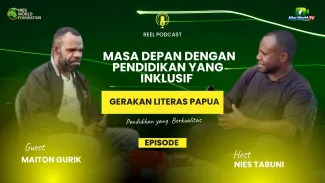
Papua Nies World TV, an organization of the Nies World Foundation founded by Nies Tabuni, a Papuan who is active in the world of content creation, has become an educational platform through short podcasts covering various important topics. Nies, known for his camera lens, invites trusted and experienced sources to share educational and beneficial information with the community. Although each podcast is only around 20 to 30 minutes long, the messages delivered are still inspiring.
The literacy problem in Papua lies not only in the low student graduation rate, but also in basic skills such as reading and writing, which remain serious challenges. Shockingly, in some schools, second-grade elementary school students cannot even read a complete sentence. Similarly, students in fourth to sixth grades still face the same difficulties. Even more concerning, the ability to read and comprehend texts has not yet been mastered by the majority of junior high and high school students in Papua.
This phenomenon reflects a literacy crisis that could threaten the future of the Papuan generation. One of the main causes of low literacy is the high rate of teacher absenteeism. In some areas, only three to four teachers attended out of the 11 expected. Difficulty in accessing transportation, limited facilities, and low incentives for educators working in remote areas exacerbate this situation.
Furthermore, the national curriculum implemented in Papua is often inappropriate for the local context of Papuan communities. The lack of educational infrastructure, such as schools, libraries, textbooks, and other learning facilities, is also a major obstacle. In some remote areas, children must even walk more than 10 kilometers to get to school, over very difficult terrain.
Despite the significant challenges, Nies Words and its team have already begun to mobilize and are committed to continuing to drive the wheels of change. The literacy movement in Papua is not solely the responsibility of a particular individual or institution, but rather the responsibility of all of us. The government, community, and literacy activists need to work together to create an inclusive, adaptive, and high-quality education system.
Education and literacy are not just about budgets; they are also about intention, strategy, and ongoing collaboration. This isn't just about catching up, but also about building a better and more sophisticated future for Papua.
Source: Nirmeke.com